I’ve been thinking a lot lately about the tension between execution and elegance.
There’s a pretty familiar trap for many who have thought about starting something new. You want the idea to be a little clearer, the plan a little tighter, the product more polished. Maybe you want to think about it for another week before you finally send the email or put something into the world.
Some of that is good judgment and restraint. But it can also become a very comfortable way to avoid actually doing anything.
The more I’ve thought about it, the more I’ve come to believe that a lot of elegance is earned. You get to the cleaner answer by starting with the messier one, putting it in front of the world, seeing what happens and adjusting from there. Put plainly, execution begets elegance.
Which raises a separate question: if execution is the critical input, what actually makes someone good at execution? I don’t think it’s just speed. And I don’t think it’s just being smart or working hard.
One framing I’ve found useful is Elo + APM.
Elo is a ranking system originally developed for chess and now used across competitive games. I’m borrowing the term pretty loosely here to mean judgment: how good are you at reading the situation, figuring out what matters and making the right call with imperfect information?
APM means actions per minute. Again, I’m using it loosely. I don’t care how quickly someone can clear their inbox. I care about how often they turn thought into action and action into feedback.
Put those two things on a grid and you get something like this (pardon the somewhat corny titles):
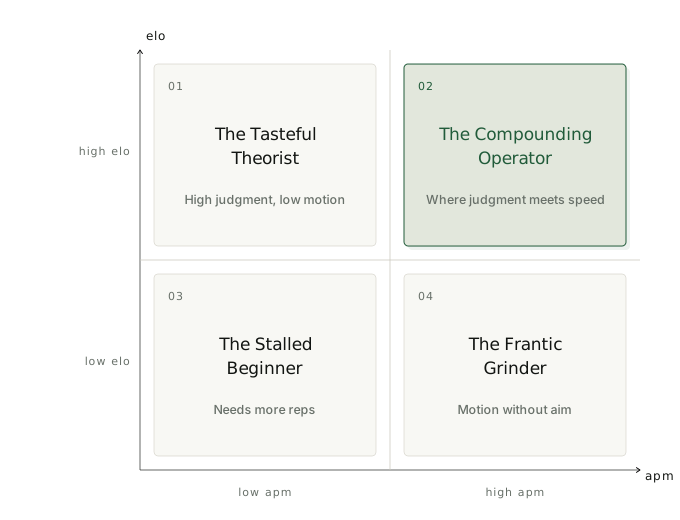
The Tasteful Theorist has good instincts but doesn’t take enough shots. They may see the game better than most people, but spend too much time waiting for the perfect move.
The Frantic Grinder takes plenty of shots, but without enough judgment about where to aim. This is the person who is always doing something, though it isn’t always clear that the activity is getting them anywhere.
The Stalled Beginner doesn’t yet have much of either. But in some ways the prescription here is straightforward. They need reps / higher APM.
The quadrant I think is most dangerous is the Compounding Operator. This person has good judgment and moves quickly. More importantly, those two things feed each other. Good judgment means you spend more of your time taking shots that matter. But taking a lot of shots is also one of the ways you develop good judgment in the first place. You try something, see what happens, and adjust. Then you do it again. Over time, you’re both moving faster and getting better at deciding where to move.
I think the investing cliché that “time in the market beats timing the market” is relevant here and conveys a similar idea. The part I like about that idea isn’t really about investing, it’s that compounding requires exposure. You have to be in the game long enough, and taking enough swings, for the feedback loops to start working in your favor.
The same thing seems true of work. If you want better judgment, you need to give yourself things to have judgment about. Make a prediction, make the decision, and see how it turns out. Spend time around people who are unusually good at what they do and pay attention to what they notice. When you get something wrong, try to figure out why rather than smoothing over the miss after the fact.
I suspect a lot of what we call good judgment is really accumulated pattern recognition from doing this over and over again.
APM is a little different. A lot of it comes down to making action cheaper / more frictionless.
Send the email instead of drafting it six times. Put the rough version in front of someone. Make the call. Build the prototype. Ask the question. If a decision is reversible and the downside is limited, make it and keep going.
To be clear, none of this means being careless. And high APM definitely shouldn’t mean being busy for the sake of being busy. The useful actions are the ones that get you some new information that can feed the compounding machine.
I think the framework is helpful when evaluating other people too.
APM is usually fairly easy to see. Some people just leave a wake behind them where things happen. Meetings get scheduled, customers get called, products get shipped, loose ends disappear.
Elo takes longer to assess. You start to see it in which problems someone chooses to work on, what they ignore, whether they anticipate issues before they become obvious and, maybe most importantly, whether their decisions seem to improve as they get more information.
The people who have both are rare. They’re not necessarily the smartest person in the room, and they’re not necessarily the person working the longest hours. They just seem to spend an unusually high percentage of their time doing things that matter, learning from what happens and moving again.
That’s increasingly what I have in mind when I think about great execution. And it’s why I like execution over elegance as a general rule. There are obviously times when getting something exactly right matters. But in most cases you're probably far more likely to get there by starting, learning and refining than by trying to reason your way to the perfect answer before you even begin.